White Label SEO Reporting: The Complete Agency Guide (2026)
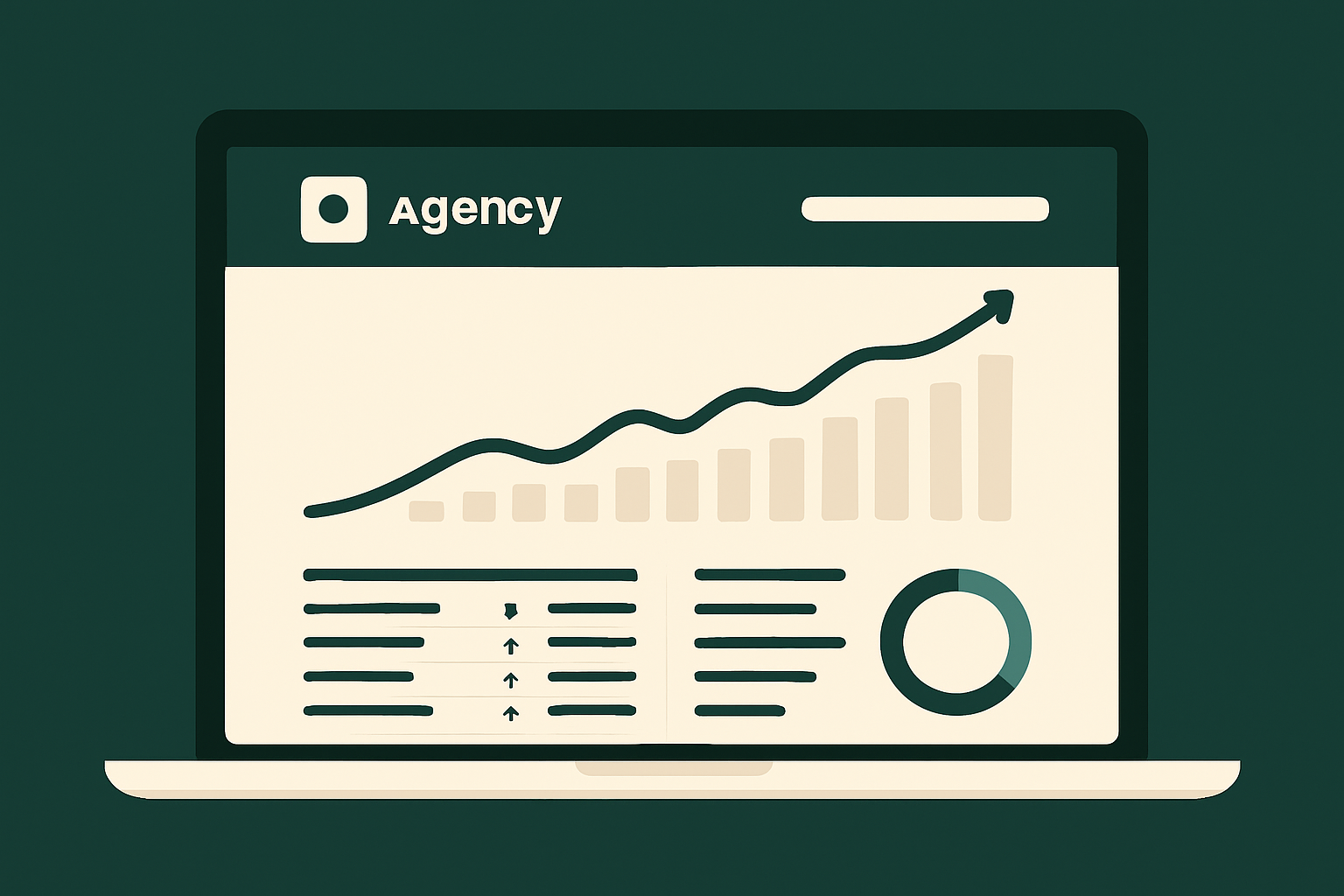
Most clients don't read their SEO reports. Not because they don't care — because the reports are built for the agency, not the client. They lead with domain authority scores and raw backlink counts, metrics that mean nothing to a business owner trying to understand whether their SEO investment is paying off. This guide covers what to put in a white label SEO report, what to cut, and how to build a reporting process that actually retains clients.
What Is White Label SEO Reporting
White label SEO reporting is the practice of delivering branded performance reports under your agency's name — without exposing the underlying data sources or tools. Clients see a report with your logo, your colour scheme, and your narrative framing. The data itself comes from integrations with Google Search Console, Google Analytics, and rank tracking tools, all surfaced through a branded interface or PDF.
The "white label" distinction matters for two reasons. First, it preserves the perception of in-house expertise — clients don't need to know you're using AgencyAnalytics or Nightwatch to pull the data. Second, it creates a consistent brand experience across every client touchpoint, which reinforces retention. A report that looks like it came from your agency is more likely to be kept, shared internally, and referenced in renewal conversations than a generic platform export.
What white label SEO reporting is not: a dump of every metric a tool can export. That approach is where most agencies lose clients — not because the SEO work is poor, but because the report makes the client feel like they're reviewing a spreadsheet rather than understanding their business.
The core principle: clients pay for your interpretation of data, not the data itself. A strong white label SEO report tells a story — what happened, why it happened, and what you're doing next. The metrics are evidence for that story, not the story itself.
What Every White Label SEO Report Should Include
A well-structured white label SEO report follows a consistent order: business outcomes first, supporting data second, raw metrics last. Most agencies get this backwards and lead with impressions and crawl stats when clients want to know whether the phone is ringing more.
1. Executive Summary (One Page)
The executive summary is the only section most clients will read in full. It should answer three questions in plain language: What improved this month? What didn't move yet? What are we focusing on next? Avoid jargon. "Organic sessions increased 18% month-over-month, driven by three new articles ranking for your target service keywords" is useful. "Domain authority is stable at 32 with 7 new referring domains" is not.
2. Business Outcome Metrics
Lead with what the client actually cares about. For most clients, this means:
- Organic conversions or leads attributed to organic traffic (the primary KPI)
- Organic sessions and users — trend line, not just monthly snapshot
- Revenue or pipeline influenced by organic, if your client has conversion tracking set up
- Top landing pages by traffic and conversion rate
If you don't have conversion tracking set up, that is the first thing to fix before adding any other reporting complexity.
3. Keyword Movement
Report on a defined set of target keywords — ideally agreed with the client at campaign start. Show current position, movement from last month, and estimated traffic contribution. Clients should see that positions are improving for terms that matter to their business, not just any terms where rankings happened to tick up.
- Primary target keywords with current rank and month-over-month change
- Newly ranking URLs (pages that appeared in top 50 this month)
- Branded vs. non-branded click split from GSC
- Featured snippet wins or losses if applicable
4. Technical Health Summary
Clients don't need a full technical crawl report every month — they need a health status. Use a pass/fail or green/amber/red framework for the key technical areas:
- Core Web Vitals status (from Google Search Console field data, not lab scores)
- Crawl errors and indexation coverage — how many pages are indexed, any new exclusions
- New broken links or redirect chains introduced this month
- Sitemap health — last submitted, pages included
When a new technical issue appears, add a single sentence explaining what it means and when it will be fixed. Technical health sections that just list errors without context create client anxiety without providing reassurance.
5. Next Month's Focus
This is the most underrated section in most white label SEO reports. A forward-looking section shifts the client's attention from evaluating past performance to anticipating future results. It makes your agency feel proactive rather than retrospective. List two or three specific actions — articles being published, technical fixes being implemented, links being built — with expected impact. This gives clients something to look forward to in the next report.
What to Stop Including in Client Reports
The metrics that make agency reports look comprehensive are often the ones that confuse and alienate clients. Cutting these does not reduce perceived value — it increases it, because the remaining metrics are suddenly legible.
Remove from your template: Domain Authority or DR scores (third-party metrics that clients Google and misinterpret), total raw backlink counts (meaningless without quality context), keyword density figures (an outdated concept that clients treat as a target to game), bounce rate (replaced by Engagement Rate in GA4 and widely misunderstood), and screenshots from third-party tools that clients cannot access to verify.
The test for any metric is simple: does this number, on its own, lead to a decision? If a client sees "Domain Authority: 32" and has no idea whether to be pleased or concerned, the metric is not earning its place in the report. Replace it with something that connects directly to their business: "Three articles published this month are now ranking in positions 8–15 for your target keywords — we expect them to move to page one within 60 days as they build authority."
The AI Search Visibility Gap Most Reports Are Missing
In 2026, a meaningful and growing share of search queries never reach a traditional results page — they are answered directly by Google AI Overviews, ChatGPT, or Perplexity. If your white label SEO reports don't track whether your client's brand is being cited in these AI-generated answers, you are measuring an increasingly incomplete picture of their organic visibility.
AI search visibility tracking measures how often a brand appears in AI-generated responses to relevant queries. An agency managing an SEO client in a competitive service category should be able to show: how many of the 20 most-searched queries in their niche produce AI Overviews, whether the client appears in those overviews, and how that changes month-over-month. This data is harder to collect than traditional rankings, but it is becoming a genuine differentiator for agencies that report on it.
The earliest adopters are already finding that content structured for AI citation — concise definitions, structured lists, authoritative sourcing — produces measurable improvements in AI inclusion rates. Including a simple AI visibility section in your white label report positions your agency as forward-thinking and addresses a question clients are increasingly starting to ask.
Choosing a White Label SEO Reporting Tool
The right white label SEO reporting tool depends on how many clients you're managing and how much of the report you want to automate. At under 10 clients, manual reports built in Google Slides or a PDF template are workable. Above 15, manual reporting can easily consume 50 or more hours monthly — a significant overhead that erodes margin and introduces reporting inconsistency.
Full-Suite Platforms
AgencyAnalytics, SE Ranking, and DashThis connect to 80+ data sources and generate fully branded PDFs and live dashboards. Best for agencies managing multi-channel clients where SEO is one of several services being reported.
SEO-Focused Tools
Nightwatch and AccuRanker prioritise rank tracking accuracy and white label PDF output without the multi-channel overhead. Better for agencies where SEO is the primary or only service being delivered.
The non-negotiable feature set for any white label SEO reporting tool: GSC and GA4 integration that matches Google's own numbers exactly (discrepancies destroy client trust), automated PDF delivery on a set schedule, full branding customisation including logo, colours, and custom domain for the dashboard link, and the ability to annotate reports with your agency's commentary rather than just raw data exports.
For the technical audit layer of your white label report — crawl errors, indexation status, site speed, broken links — AuditDepot's automated crawl surfaces these issues in a structured format that slots cleanly into your monthly technical health section. Running a fresh crawl before each monthly report ensures the technical data is current rather than based on a stale automated sweep from the previous month.
Setting Up a Repeatable White Label Reporting Workflow
The agencies with the most consistent reporting aren't the ones with the best tools — they're the ones with the most disciplined process. A repeatable monthly workflow eliminates the last-minute scramble that produces inconsistent, error-prone reports.
The Five-Step Monthly Cadence
- Day 1–2: Pull all data sources (GSC, GA4, rank tracker, backlink tool). Flag any anomalies — traffic drops, ranking movements, new technical errors — for investigation before writing narrative.
- Day 3–4: Run fresh technical crawl for each client. Document new issues and any open items carried over from last month's report.
- Day 5–7: Write the executive summary and next-month focus section for each client. These sections are what differentiates your report from a platform export and should not be automated.
- Day 8: Assemble the full report in your white label tool, apply branding, and QA against the previous month for consistency.
- Day 9–10: Deliver with a brief personal note — one or two sentences contextualising the headline metric. Clients who get a data dump churn. Clients who feel personally briefed renew.
For agencies running audits as part of their service delivery — whether onboarding new clients or running quarterly technical reviews — the technical SEO audit checklist provides the structured framework that feeds directly into the technical health section of each monthly report. Industry-specific audits (such as the finance SEO audit guide) add the vertical context that generic reports lack.
Retention insight: Agencies that include a "wins this month" section alongside problems see meaningfully higher renewal rates. Clients who feel progress is happening don't cancel. The technical issues section should always be balanced with what improved — even in a slow month, something moved in the right direction.
When to Upgrade Your Reporting Format
Most agencies start with monthly PDF reports and add live dashboards later. The trigger for adding a dashboard is usually a specific client request: "Can I just check the rankings whenever I want?" rather than a strategic decision. That is a valid reason — but it is worth building the dashboard proactively for clients above a certain retainer threshold, because the 24/7 transparency reduces inbound questions and positions the agency as more sophisticated.
The hybrid model that retains clients longest combines a live dashboard for ongoing visibility with a monthly PDF that provides the narrative context the dashboard doesn't. The dashboard answers "what is happening right now?" The monthly PDF answers "what does it mean and what are we doing about it?" Both serve different client needs and together produce fewer cancellation conversations than either alone.
Quarterly business reviews (QBRs) are the third layer for larger retainers — a 30-minute call using the white label report as the agenda, covering progress against the goals set at the start of the engagement. Agencies that conduct QBRs consistently report higher retention rates than those that deliver reports without scheduled interpretation sessions, because QBRs rebuild alignment before it drifts into dissatisfaction.
Frequently Asked Questions
What is white label SEO reporting?
White label SEO reporting is the practice of generating branded performance reports under your agency's name — without revealing the underlying tools or data providers. Clients receive a report that looks like it was built entirely in-house, with your logo, colour scheme, and narrative framing. The data typically comes from integrations with Google Search Console, Google Analytics, and rank tracking tools, all presented through a branded interface or PDF.
What metrics should be in a white label SEO report?
Lead with business outcomes: organic conversions, leads attributed to organic traffic, and revenue contribution if trackable. Follow with traffic context (sessions, users, top landing pages), then keyword movement (ranked positions for target terms), then technical health (Core Web Vitals pass/fail, crawl errors, indexation status). In 2026, an AI search visibility section — tracking brand citations in ChatGPT, Perplexity, and Google AI Overviews — is increasingly expected by sophisticated clients.
How often should agencies send SEO reports to clients?
Monthly reports remain the standard cadence. The monthly cycle aligns with billing, gives enough time for meaningful trend data, and creates a natural checkpoint for strategy adjustments. Some agencies supplement monthly reports with a live dashboard clients can check anytime — this reduces ad-hoc data requests without replacing the monthly narrative that explains what the numbers mean.
What tools are used for white label SEO reporting?
Popular white label SEO reporting tools include AgencyAnalytics, SE Ranking, Nightwatch, DashThis, and Swydo. Each connects to Google Search Console and Analytics for organic data, then layers in rank tracking and technical audit feeds. AuditDepot is used by agencies for the technical audit layer — running crawls and surfacing issues that get packaged into the technical health section of the monthly report.